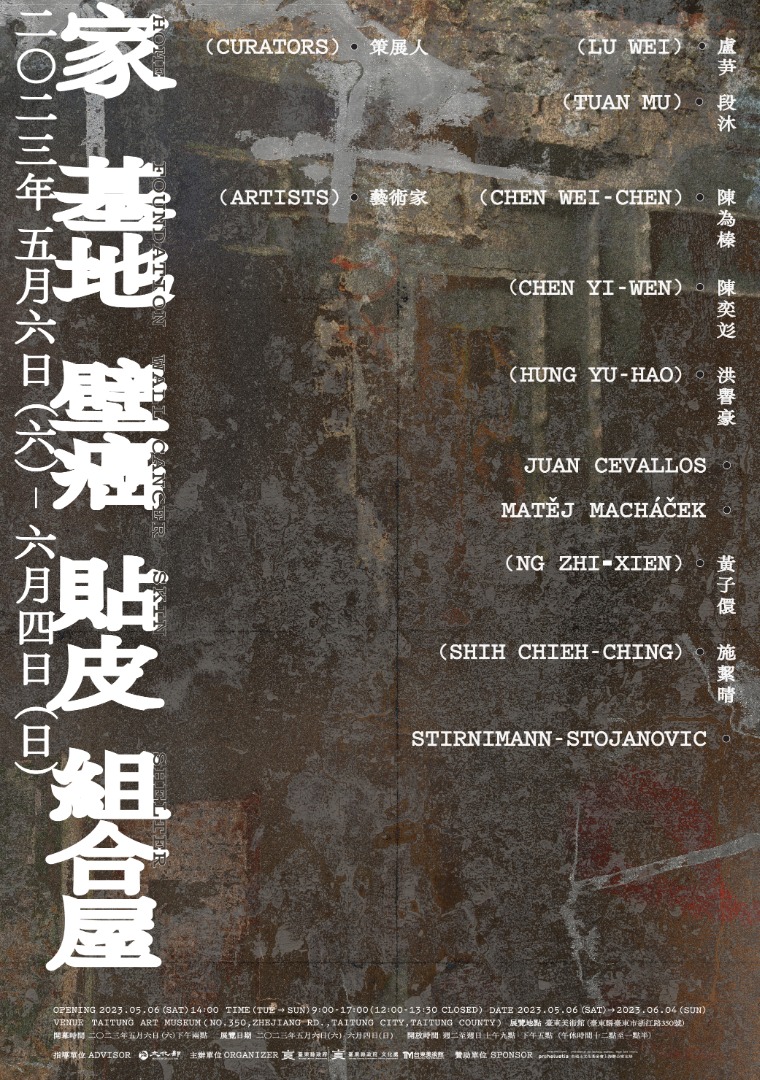
家:基地、壁癌、貼皮和組合屋 Home: Foundation, Wall Cancer, Skin, and Shelter
我們的世界正在改變,對於家的理解也隨著變化,疫情期間被迫生活於同一個屋簷下的家庭,或是因為遷移必須搭建起臨時性的居所……等,皆鬆動了原先家的界線。居所可以是移動或是扎根的,也衍生出家庭的依戀、暴力、政治、文化等議題,家的新型態漸漸地被勾勒出來。家園不再是停滯和穩定的,遷移也具有流動性的想像力,而移動不僅發生在人離家時,也涉及家屋並不總是固定著,我們該如何界定家的邊界?離開家後,回返可能意味著什麼?進而如何重新理解人和土地之間的牽絆?
展覽以四種家屋的特徵作為子題,包含「基地」、「壁癌」、「貼皮」和「組合屋」四項敘事的脈絡。「基地」是建築物的基礎和家園的根,也作為如秘密基地般的活動特定場所。「壁癌」除了回應台灣家居因氣候的潮濕導致的常見現象,也象徵著家庭內難以根除且錯綜複雜的潛在問題。「貼皮」經常用於因經濟的限制,而在家具和裝潢上創造仿真的質感,在展覽中「貼皮」也涉汲現代化及數位化後對於異質貼皮樣態的重新想像。最後的「組合屋」回應空間組成的輕巧和多樣性,透過重組家的殼和碎片,具有臨時性和庇護的特質,思考其混合特性家屋的指向。展覽邀請了來自臺灣、馬來西亞、捷克、厄瓜多、瑞士和塞爾維亞共九位藝術家,共同建構跨文化脈絡下「家」的敘述和回返,透過多樣化的媒材勾勒出某個時段下家的型態,同時以流動和多樣性的特徵開啟了具有想像力的對話。
Our world is changing, and along with it, our understanding of what a home means. During the pandemic, some families were forced to live under a same roof, others emigrated and had to set up temporary residences - all of these contributed to loosen the original outline of what a “home” is. A home can be mobile or rooted: it is from “home” that notions of family attachment are derived, but also issues of violence, politics and culture. Through all, little by little, a new form of home is being drawn. Our homeland is no longer stagnant or steady, migration also possesses fluidity in its imagination. Since this movement occurs when people leave their home but also involves houses themselves, for houses aren’t established once and for all, how should we define the borders of a home? After leaving home, what could “returning” signify? Furthermore, how can we understand the bond between people and their land in a new way?
The exhibition takes the characteristics of four kinds of houses as subthemes, consisting of “base”, “wall cancer”, “skin” and “shelter”. “Base” is the architectural foundation and root of the house, as well as the secret place designed to hold activities. “Wall cancer” can correspond to the common appearance of walls in Taiwanese houses, as a consequence of the humid climate, but it also symbolises the difficult, intricate and underlying problems of a family. “Skin” is related to contact papers, it is often used as a cost-effective choice under economical constraints, to emulate textures on furniture and decorations. It is also related to the reimagining of “skins” as appearances after the impact of digitalisation in our modern society. The last chapter “Shelter” is about the nimble and diverse nature of space composition. By recombining the shell and fragments of a home, we can think about what hybrid houses may develop and suggest. This exhibition invited in total nine artists, from Taiwan, Malaysia, Czech Republic, Ecuador, Switzerland and Serbia, to work together and construct both a narrative and a return to “home” in a cross-cultural context. Through a variety of media, they were invited to outline the form of “home” at a certain moment in time, as well as open up an imaginative dialogue, through the attributes of fluidity and diversity.
活動時間與地點
臺東美術館